
Monday, April 11, 2011
Proteomics = Sushi?
New discoveries of change in proteins after translation, many forms of proteins being encoded in our cells by single genes and alternative roles of RNA are allowing us to realize that things aren't as simple as we once believed. Scientists found out that changing when and where a protein is expressed can result in very different functions for that protein. This realization gave way to Proteomics which is the study of proteins. While being coined it's name after Genomics, Proteomics is much more complex. Also, the genome is often a constant entity while the proteome is different from each cell and is constantly changing due to the environment. Scientists now have to catalog all human proteins and assess their functions/interactions which can be seen as nearly impossible. But there is an international collaboration called the Human Proteome Organization or HUPO which helps achieve these goals more precisely and quickly.


Friday, April 1, 2011

Monday, March 28, 2011
PCR and Genetic Disease
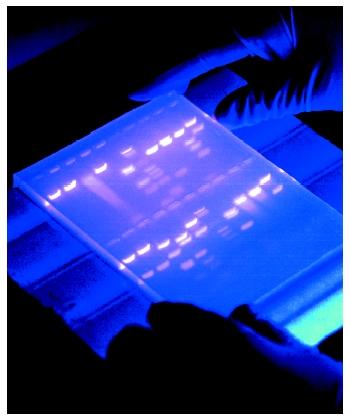
In this lab we are using PCR in order to track any genetic disease we might, but hopefully don't carry. Like in any Polymerase Chain Reaction, the main goal is to first create large amounts of DNA from a small amount for each person in the lab group which is called amplification. We will be amplifying our gene of interest (GOI) which will be our anonymous "genetic disease".
Procedure
Day 1:
We begin our lab by collecting cheek cells. In order to obtain a sufficient amount of cells, we first clean our mouths, then chew on our inner cheek for a few minutes. After that, we rinse our mouth with saline solution for 30 seconds and pipet the solution into a micro test tube labeled with our initials. we then centerfuged the saline/cheek cell solution which created a pellet sized collection of cells at the bottom of the tube. We then seperated the excess saline and pellet from one another and inserted teh pellet into another micro test tube which contained InstaGene. The microtubes then went through a series of hot water baths and then vortexed the the tubes to resuspend our cells.
Day 2:
On day 2 the first order of business was to centerfuge our test tubes which had been refrigerated overnight for 2 minutes at 6,000 x g. We then transdered 20 micro liters of the supernatant into the bottom of our PCR tubes being careful not to also transfer any matrix beads. Then 20 micro liters of the master mix was added to the PCR tubes. Lastly the PCR tubes were put into a thermacycler.
Day 3:
For day 3, be immediately pulse centerfuged the tubes for about 3 seconds. then 10 micro liters of loading dye was added to our PCR tubes and mixed. The agarose gel was then loaded into the apparatus and the electrophoresis chamber was covered with lysis buffer. We then loaded each sample into the gel along with two homozygous controls, a heterozygous control and a MMR (DNA standard).
Results:
On day 4 of our lab, we had our results. Thankfully, each one of the students in our lab group tested negative for this "mystery gene". But this does not mean that we are 100% safe from this unknown diseasse, because there are many instances of error that occur during the lab. One of them would be accidentally
Tuesday, February 1, 2011
Tomatoes on Steroids
Intro:

Foods such as tomatoes are the most popular subjects to be genetically modified. Our resources on things such as food are becoming scarce due to over consumption, and many think that our last hope may be the use of GMOs. But others oppose the use of GMOs due to them being too artificial. Also, GMOs may pose health concerns due to their side affects. But the idea of genetically modified organisms is not a new sensation. Farmers have been modifying their crops against pesticides, disease, and limited growth for centuries.

How are genes made? Well is all starts with the gene of interest (GOI). The GOI is taken from the plasmid and put into the agro bacteria. Once that is done, the GOI along with the bacteria is inserted into the plant cell. This is how scientists/farmers create plants that become resistant to many things such as harsh weather, insects, or even disease. GMOs are identified mainly by a Polymerase Chain Reaction, also known as PCR. During PCR, sequences of DNA that are inserted into the GM plant are identified.

Procedure:
Day 1
In our lab we will be testing a corn flower substance and orange to see if they are genetically modified. Our first step is to weigh out 0.5-2 g of each sample and then grind down them down with a mortar after adding 5 ml of distilled water. Once this is done we will pipet them into 6 different test tube. Then we will place them in a 95 degree water bath for approximately 5 minutes. Lastly we will place them in a refrigerator until the next day.
Day 2
On the second day we place our six test tubes in capless microtube adaptors and place them in an ice bath. Then we add the master mix to each PCR tube, and once that is done, we add the indicated DNA to each PCR tube. We mix these two substances by pipetting up and down.
Day 3
On our last day of the lab we start our gel electrophoresis. First we add Orange G loading dye to each sample and mix. once this is done, we load our six dyes in the gel. After, Mr. Chugh loaded our control in lane 7. We then stained the gel. These are the results below.

Results:
As you can see, in lane 6 and 5 there is a very clear band at 200 bp. These two lanes represented the corn flower that was provided to us. Further along in lanes 4 and 3, it is hard to tell, but the orange that we used also came up on the 200 bp band. This proves that both samples we used in the lab tested positive for GMO.
Tuesday, January 25, 2011
pGLO(w) Tansformation

Green Flourescent Protein or GFP's are responsible for a sea jelly's ability to glow in the deepest parts of the ocean. In this experiment, we will see how plasmids move genes from one organism to another. This process allows bacteria in nature to adapt to their environments by transferring plasmids back and fourth with the beneficial genes and makea them better suited for the new conditions. This phenomena is what allows bacteria to gain a fast resistance to antibiotics, thus making them virtually unstoppable.
The pGLO that we will be using in our experiment encodes the gene for the Green Fluorescent Protein (GFP) and also incorporates a gene regulation system which controls the fluorescent protein. In this lab, we will perform the genetic transformation using plasmids.
Monday, November 15, 2010
Genes: Seeing is Believing
Thanks to new technology, scientists are now able to view genes with their bare eyes. Because of this, we can now find what genes are doing their job, and which genes are causing things such as cancer or disease. The main piece of technology we use to see these genes is called a microarray. A microarray is a sort of scanning method where genes or DNA is placed or printed on a glass slide and then "scanned" different colors to distinguish between the unusual genes.

The different colors represent, for example, the cancerous or noncancerous cells. The cancerous cells would be colored red, while the noncancerous cells would be green.

The different colors represent, for example, the cancerous or noncancerous cells. The cancerous cells would be colored red, while the noncancerous cells would be green.
Monday, October 25, 2010
Forensic Files
DNA profiling or "fingerprinting" has been used in many situations to discover the true identities of different organisms. the main field of work that DNA profiling is used in is law enforcement. Scientists working with the police can solve various crimes by analyzing DNA and matching it with other samples. Restriction Fragment Length Polymorphism also known as RFLP was first introduced by Alec Jeffries, a geneticist, in 1985. RFLP creates a binding pattern based on the restriction sites in a person's DNA makeup. Today, we use polymerase chain reaction or PCR amplification to conduct DNA profiling which is a much quicker process.

A very important natural tool that scientists use for DNA profiling are Restriction Enzymes. Restriction Enzymes act like molecular scissors which cuts out and destroys DNA from invading viruses or phages. Reaction Enzymes first recognize the specific DNA sequences in phages or viruses and then cut the DNA at that site.

Agarose Gel creates groups of DNA which are separated by their size. DNA pieces are put into slabs of agarose gel which is then placed in a buffer solution. A current is sent through the agarose slab which causes the negatively charged DNA fragments to move toward the positive pole or anode. Inside the agarose gel slab, smaller DNA fragments can move more freely than larger ones, therefor smaller DNA fragments can travel further than large fragments.


A very important natural tool that scientists use for DNA profiling are Restriction Enzymes. Restriction Enzymes act like molecular scissors which cuts out and destroys DNA from invading viruses or phages. Reaction Enzymes first recognize the specific DNA sequences in phages or viruses and then cut the DNA at that site.

Agarose Gel creates groups of DNA which are separated by their size. DNA pieces are put into slabs of agarose gel which is then placed in a buffer solution. A current is sent through the agarose slab which causes the negatively charged DNA fragments to move toward the positive pole or anode. Inside the agarose gel slab, smaller DNA fragments can move more freely than larger ones, therefor smaller DNA fragments can travel further than large fragments.

Subscribe to:
Comments (Atom)